How to Find a Percent of a Number
Use decimals to calculate discounts, tips, tax, grades, and everyday percent problems.
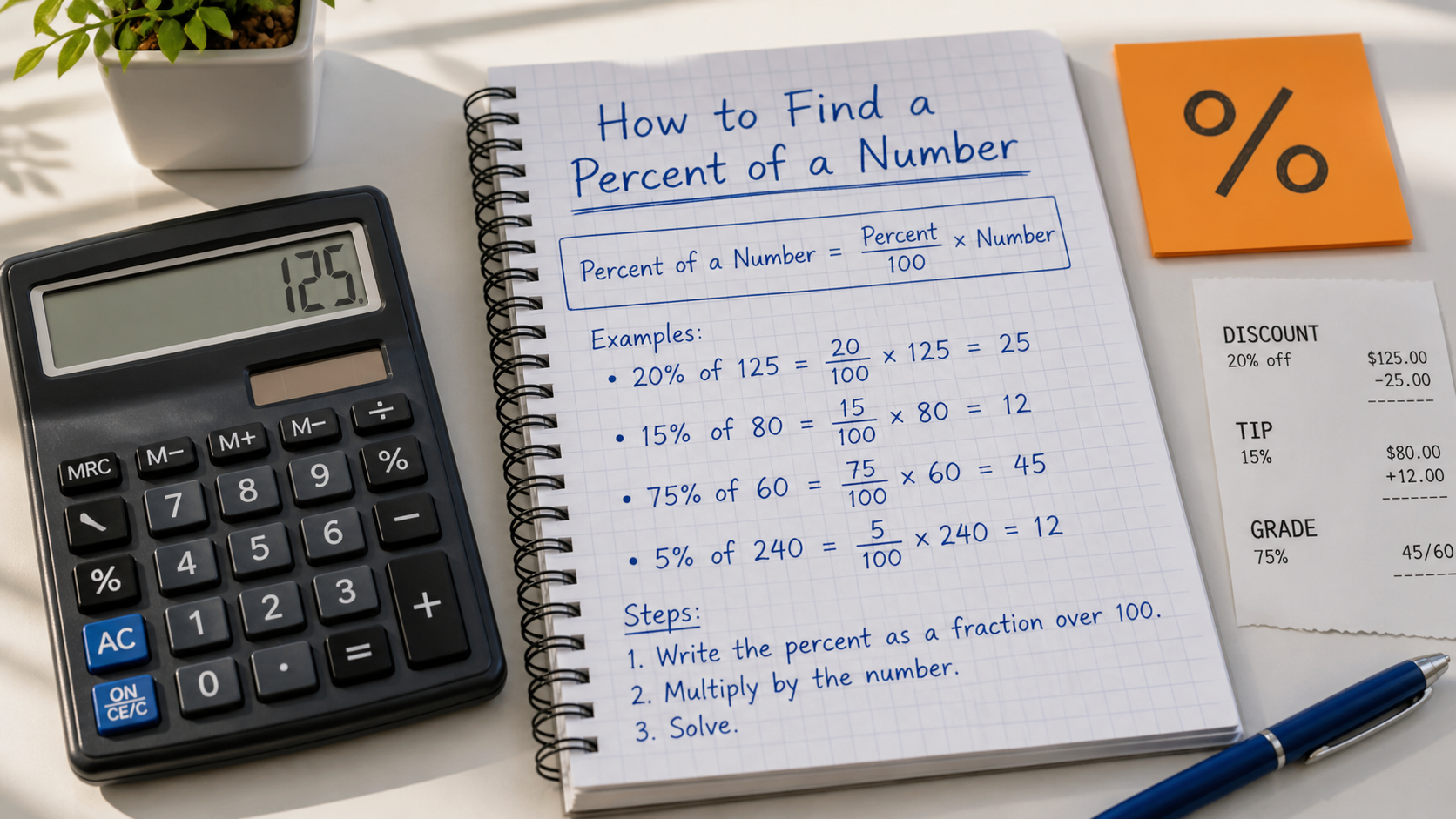
Quick Answer
part = (p / 100) × wholeWhen to Use This
Find a share of a known base when calculating a tip, discount amount or allocation. Identify whether the question wants the share itself or the final amount after adding or subtracting it.
Step-by-Step Method
- Identify the percentage p and the whole it applies to.
- Convert p to a decimal by dividing by 100.
- Multiply the decimal by the whole.
- Add or subtract that share only if the question asks for a final total.
Calculator Tips and Limits
- The percent-of-number tool returns the part, not automatically a discounted price.
- On the homepage you can also ask 15% of 240 to populate the same calculation.
Worked Examples
A discount amount and sale price
15% of 240 = 0.15 × 240 = 36. If 240 is the original price, a 15% discount removes 36 and leaves 240 - 36 = 204. The share is 36; the sale price is 204.
More than one whole
125% of 80 = 1.25 × 80 = 100. This is larger than the base because 125% describes one whole plus another quarter.
Common Mistakes
Multiplying by 15 instead of 0.15
15 × 240 is one hundred times the requested 15% share.
Using the wrong base for a tip or tax
Check whether the percentage is applied before or after another charge. Different bases produce different amounts even with the same rate.
FAQ
How can I check the 36 result quickly?
10% of 240 is 24 and 5% is 12. Together they are 36.
How do I find the percentage when the share is known?
For a nonzero whole, divide part by whole and multiply by 100: 36/240 × 100 = 15%.
References and corrections
OpenStax: Prealgebra 2e — further reading. The worked examples on this page are CalcSolver explanations. Read our calculation and correction method, or report an error with the input and expected result.