Percent to Decimal: Conversion Steps and Common Traps
Move the decimal point correctly, compare equivalent forms, and avoid common percent mistakes.
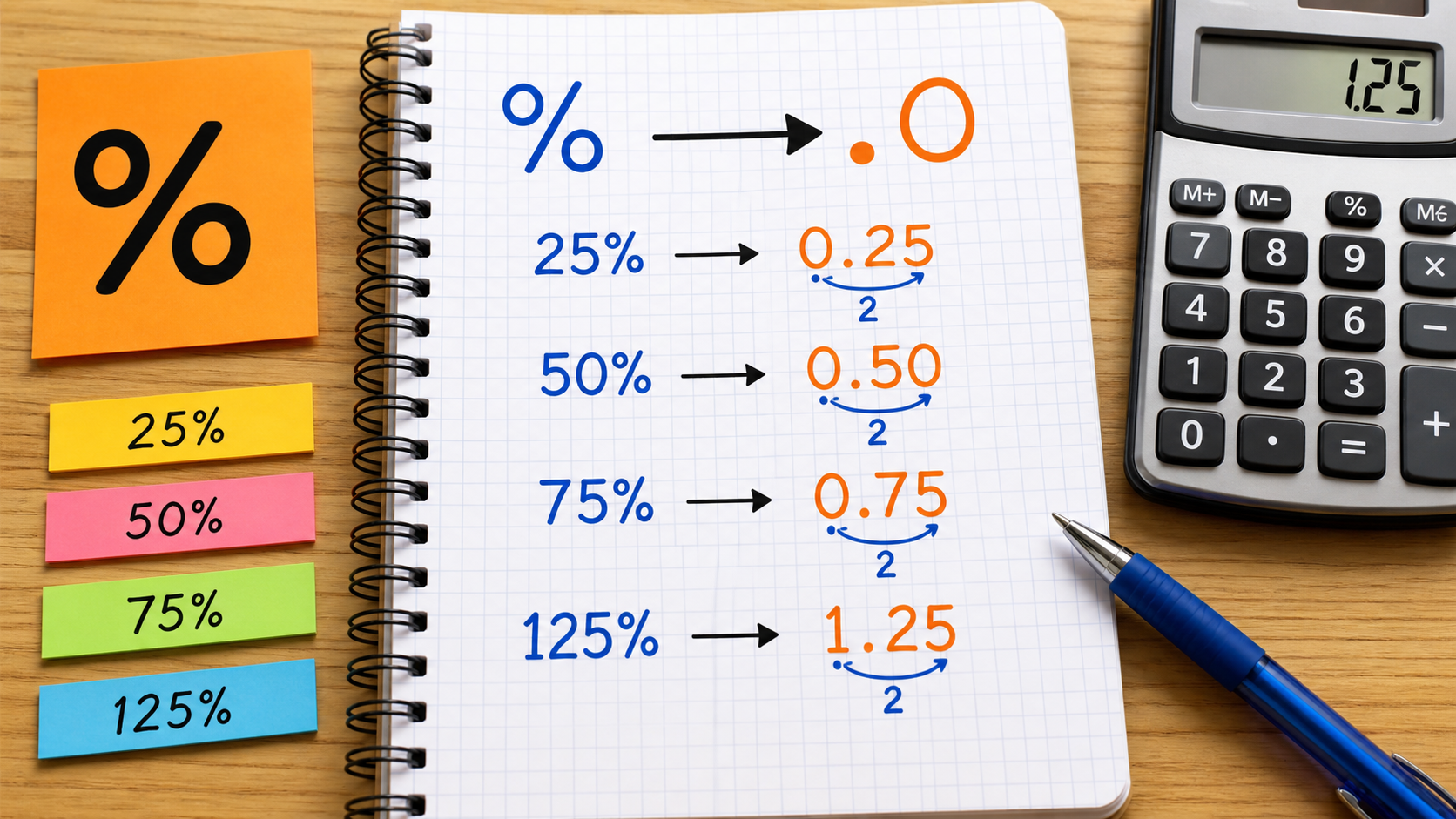
Quick Answer
decimal = percent / 100; percent = decimal × 100When to Use This
Convert a rate before using it as a multiplier. A percentage is written in units of one hundredth, while a decimal is a numerical factor. Conversion does not yet calculate an amount such as a discount in dollars.
Step-by-Step Method
- Take the numerical part of the percentage.
- Divide by 100 exactly once.
- Write a leading zero for a positive result below 1.
- Multiply the decimal by 100 to check the original percent.
Calculator Tips and Limits
- Use the basic calculator division button for a transparent conversion: enter 8.5 / 100.
- The percent key may be convenient, but do not also divide its converted output by 100.
Worked Examples
Convert a fractional percent
8.5% = 8.5/100 = 0.085. Reversing it, 0.085 × 100 = 8.5, so the original rate is 8.5%. If the base amount is 200, that rate represents 0.085 × 200 = 17.
Small and large rates
0.5% = 0.005, not 0.5. Conversely, 150% = 1.5: a percentage can exceed 100 when it describes more than one whole.
Common Mistakes
Moving one place instead of two
8.5% is 0.085, not 0.85; the latter represents 85%.
Confusing 0.5 with 0.5%
0.5 is one half, while 0.5% is one two-hundredth. The percent sign changes the scale.
FAQ
Can a percent be negative?
Yes, for example a signed change of -4% corresponds to -0.04. Its meaning depends on the quantity being described.
Do I round a conversion?
Dividing a terminating decimal by 100 is exact. Round only if the subsequent measurement or calculation requires it.
References and corrections
OpenStax: Prealgebra 2e — further reading. The worked examples on this page are CalcSolver explanations. Read our calculation and correction method, or report an error with the input and expected result.