Solve for X Step by Step
Use inverse operations, keep both sides balanced, and verify the answer by substitution.
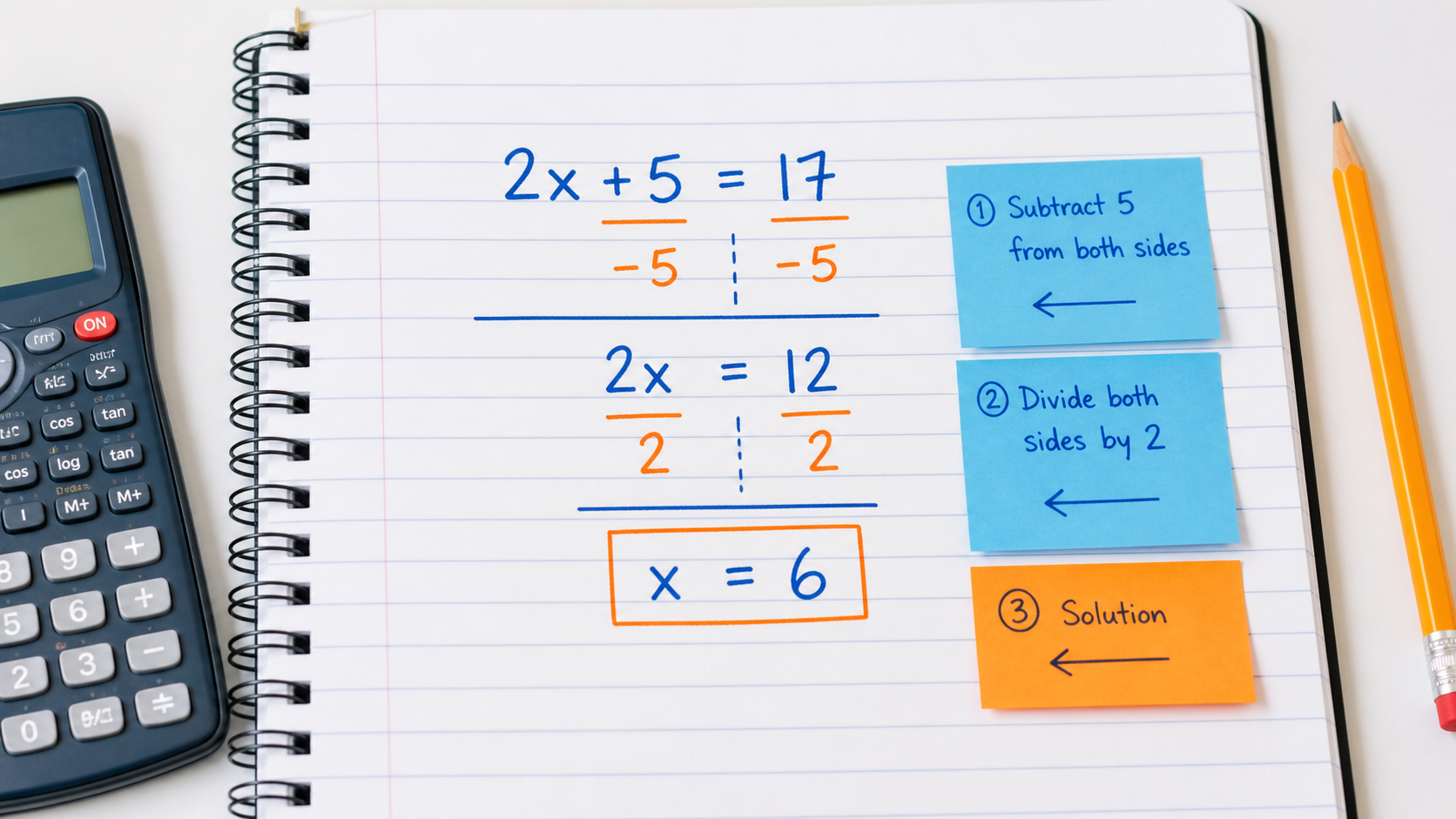
Quick Answer
3x + 7 = 22 → 3x = 15 → x = 5When to Use This
Isolate an unknown while preserving equality. Each operation must affect both sides. The aim is to transform the equation into an equivalent one whose solution is easy to read, then check that solution in the original equation.
Step-by-Step Method
- Identify the coefficient multiplying x and the constant term.
- Subtract the constant from both sides.
- Divide both sides by the nonzero coefficient.
- Substitute the candidate value into the original left and right sides.
Calculator Tips and Limits
- The linked solver supports linear x terms, addition/subtraction and one equals sign.
- Simplify parentheses and fractions on paper before entering a compatible linear equation; do not assume the tool parses every algebraic notation.
Worked Examples
Undo addition, then multiplication
Solve 3x + 7 = 22. Subtract 7 on both sides: 3x = 15. Divide both sides by 3: x = 5. Substituting gives 3 × 5 + 7 = 22, equal to the right side.
A negative coefficient
For -2x + 4 = 10, subtract 4 to get -2x = 6. Divide by -2 to obtain x = -3. Check: -2 × (-3) + 4 = 10.
Common Mistakes
Changing only one side
Subtracting 7 only on the left changes which values satisfy the equation. Keep both sides balanced.
Dropping a negative coefficient
Dividing 6 by -2 yields -3, not 3. Write the sign alongside the coefficient.
FAQ
Can I divide by the coefficient when it is zero?
No. Simplify the equation and compare the remaining constants; it may have no solution or every value may work.
Does a displayed answer prove my input was correct?
No. Compare the entered equation with the original question and verify by substitution.
References and corrections
OpenStax: Algebra and Trigonometry 2e — further reading. The worked examples on this page are CalcSolver explanations. Read our calculation and correction method, or report an error with the input and expected result.